
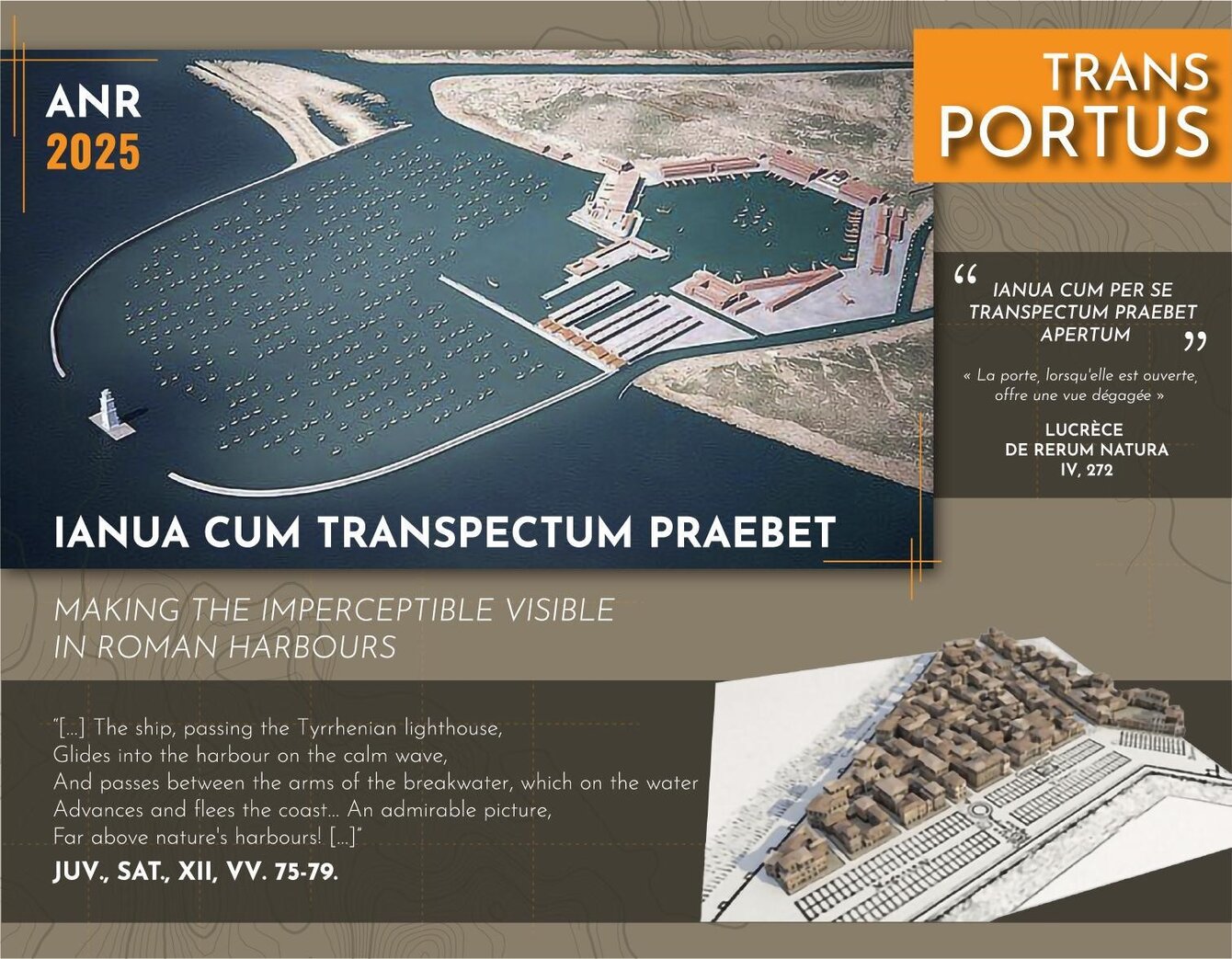
A harbour is like an (urban) organism, constantly evolving and changing, with a life made up of additions, restorations, adjustments and developments. The Trans-Portus project proposes to develop a novel approach based on a conceptual change in the harbour model. Traditionally, a harbour is defined as a combination of two components, the container (interface harbour structures) and the content (volume of sediment, water, sea level), as well as the facilities for loading/unloading, storage and management. The originality of this project lies in its attempt to transpicere (i.e. to see through) the harbour object, by recreating the conceptual link between its two components before reintegrating them into their geographical context (material supply area, coastal landscapes, etc.). To achieve this, Trans-Portus relies on a transdisciplinary consortium and on a study at nested scales, which will make it possible to answer outstanding questions concerning their technical, architectural and environmental history. The geohistorical approach will enable us to reconstruct the spatiality of ancient harbours in relation to their landscape (retail trade logic, environmental potential/constraints, etc.) and the environmental trajectories of landscapes after development. The historical approach is based on a re-reading of archaeological data and ancient texts. The geoarchaeological approach is based on deep sediment archives cored in both structures and basin infilled studied at very high chronostratigraphic resolution. In order to overcome methodological obstacles, new transfers of knowledge between the human sciences and the geosciences will be devised and implemented. The overarching objectives of Trans-Portus are to: (1) restore the particular logistical constraints imposed on builders and (2) the temporal variability of these archaeological objects in all their complexity (4D modeling).
Our contribution to the project
The LIVE laboratory is a partner in the project. We will contribute to this ANR project by providing our expertise in (1) the study of subsidence due to compaction under the archaeological structures of Portus during the Roman period and (2) the study of mid-infrared spectroscopy to trace the origin of the materials used in the construction of the Portus piers.
Ferréol SALOMON, CNRS researcher et Damien ERTLEN, Associate Professor at the University of Strasbourg
Fundings
French-Swiss ANR
Project duration
2025-2029
Coordination
Dr. Jean-Philippe GOIRAN
Collaborations
- Archéorient, UMR-5133 (CNRS, University Lyon 2) - FRANCE : Dr. Jean-Philippe GOIRAN, Dr. Hugo DELILE, Dr. Sofiane BOUZID, Dr. Claire GIGUET, Dr. Nicolas JACOB-ROUSSEAU, Dr. Cécile VITTORI, Jorge COCQUYT, Arthur DE GRAAUW
- University of Lausanne - SWITZERLAND : Dr. Brahimsamba BOMOU, Dr. Georgina King, Dr. Christoph SCHMIDT, Dr. Samuel JACCARD, Prof. Niklas LINDE, Dr. Tiffany MONNIER, Dr. Sylvie BRUGGMANN, Dr. Ludovic BARON
- Laboratoire Image Ville Environnement (LIVE), UMR-7362 (CNRS, University of Strasbourg, ENGEES) - FRANCE : Dr. Ferréol SALOMON, Dr. Damien ERTLEN
- Laboratoire Chrono-Environnement, UMR-6249 (CNRS, University of Franche-Comté) - FRANCE : Dr. Isabelle JOUFFROY-BAPICOT, Dr. Matthieu LE BAILLY
- Laboratoire Archéologie et Archéométrie (ArAr), UMR-5138 (CNRS, University Claude Bernard Lyon I, University Lyon 2) - FRANCE : Dr. Christine OBERLIN, Dr. Olivier TOMBRET, Dr. Julien LACHARME
- Ecole Nationale Supérieure d'Architecture de Lyon - MAP-Aria - FRANCE : Dr. Renato SALERI